In today’s digital landscape, where attention is the ultimate currency, blogging stands out as a versatile and powerful tool for individuals and businesses alike. Far more than a platform for sharing thoughts, blogging is a strategic asset that can elevate your online presence, connect you with audiences, and drive measurable growth. Whether you’re a small business owner, a creative professional, or an entrepreneur, a well-maintained blog can transform how the world perceives and interacts with you online. This article explores how blogging enhances visibility, fosters audience connection, establishes authority, and fuels business growth, offering actionable insights to harness its potential.
The internet is crowded, with millions of websites vying for attention. Yet, blog writing remains a proven method to stand out. According to HubSpot, businesses that blog generate 55% more website visitors and 67% more leads than those that don’t. These numbers highlight blogging’s ability to amplify your reach and impact. By creating valuable, relevant content, you not only attract visitors but also build trust and loyalty, turning casual readers into dedicated followers or customers.
Blogging’s versatility makes it accessible to anyone with a story to tell or a goal to achieve. It’s a low-cost, high-impact way to showcase expertise, share insights, and engage with a global audience. From improving search engine rankings to sparking meaningful conversations, the benefits of blogging are both immediate and long-term. This article will dive into four key areas: how blogging boosts visibility through search engine optimization (SEO), deepens audience connections, establishes brand authority, and drives business growth. We’ll also address common challenges and provide practical solutions to ensure your blogging efforts succeed.
By the end, you’ll understand why blogging is not just an option but a necessity for anyone looking to thrive online. Whether you’re starting fresh or reviving an old blog, the strategies outlined here will help you maximize its transformative power. Let’s explore how blogging can reshape your online presence and set you on a path to digital success.
Enhancing Visibility Through SEO
One of the most compelling reasons to blog is its ability to boost your website’s visibility through search engine optimization (SEO). Search engines like Google prioritize websites that offer fresh, relevant, and high-quality content. Blogs provide the perfect opportunity to meet these criteria, driving organic traffic and making your site more discoverable to potential audiences.
At its core, blogging enhances SEO by allowing you to integrate keywords naturally into your content. By researching and targeting terms your audience searches for, you can create posts that align with their needs, increasing the likelihood of ranking higher on search engine results pages (SERPs). For example, a bakery blogging about “gluten-free cupcake recipes” can attract local customers searching for those terms. Regular posting also signals to search engines that your website is active, improving its authority over time. According to a 2023 study by Orbit Media, websites with blogs have 434% more indexed pages, significantly increasing their chances of being found online.
The impact of this increased visibility is profound. More organic traffic means more visitors discovering your products, services, or ideas without relying heavily on paid ads. This expanded reach can attract new customers, followers, or collaborators who might never have found you otherwise. For instance, a tech startup blogging about “AI trends in 2025” could draw in industry professionals seeking cutting-edge insights, positioning the brand in front of a targeted audience.
To maximize SEO benefits, focus on creating high-quality, evergreen content that answers your audience’s questions. Tools like Google Keyword Planner or Ahrefs can help identify relevant keywords, while plugins like Yoast SEO ensure your posts are optimized for search engines. Additionally, internal linking to other blog posts or pages on your site keeps visitors engaged longer, further boosting SEO.
A real-world example is Neil Patel, a digital marketing expert whose blog ranks for thousands of keywords, driving millions of monthly visitors. By consistently publishing in-depth, keyword-rich content, he’s turned his blog into a traffic-generating machine. You don’t need to be a marketing guru to achieve similar results—start with a clear SEO strategy and commit to regular posting. Over time, your blog will become a magnet for organic traffic, transforming your online visibility.
Building a Deeper Connection with Your Audience
Blogging is more than a marketing tool; it’s a platform for authentic storytelling that fosters deep, meaningful connections with your audience. In an era where consumers crave authenticity, blogs allow you to share your brand’s values, mission, or personal journey, humanizing your online presence and building trust.
Unlike social media posts, which are often fleeting, blog posts offer space to dive into topics that matter to your audience. For example, a sustainable fashion brand might share a post about its ethical sourcing process, giving readers insight into its values. This transparency resonates, as 88% of consumers say they’re more likely to trust brands that share authentic content (Stackla, 2021). By addressing your audience’s pain points or aspirations, you create content that feels personal and relatable, encouraging loyalty.
Blogs also spark engagement through comments, shares, and discussions. By inviting feedback or asking questions in your posts, you create a two-way conversation that makes readers feel heard. For instance, a fitness coach blogging about “5 Common Workout Mistakes” could end with a prompt like, “What’s your biggest fitness challenge?” This invites readers to share their experiences, fostering a sense of community. Social sharing buttons make it easy for readers to spread your content, amplifying your reach and deepening connections.
A powerful example is the blog of lifestyle influencer Marie Forleo, whose posts blend personal anecdotes with actionable advice. Her relatable storytelling has built a loyal community of millions, with readers engaging through comments and social shares. You can achieve similar results by writing in a conversational tone and addressing your audience’s needs directly. Tools like Disqus can streamline comment management, while analytics platforms like Google Analytics help track engagement metrics.
To strengthen audience connections, focus on consistency and authenticity. Share behind-the-scenes stories, respond to comments promptly, and tailor content to your audience’s interests. Over time, these interactions transform casual readers into a dedicated community, enhancing your online presence with a network of engaged supporters.
Establishing Brand Authority and Credibility
Blogging is a powerful way to position yourself or your business as an authority in your field. By sharing valuable, well-researched content, you demonstrate expertise and build credibility, making your brand a trusted resource for your audience.
In-depth articles, tutorials, or industry insights showcase your knowledge and set you apart from competitors. For example, a financial advisor blogging about “How to Plan for Retirement in Your 30s” can provide actionable tips that establish them as an expert. This content not only educates readers but also builds confidence in your abilities. According to Content Marketing Institute, 60% of consumers are more likely to trust companies that provide educational content, highlighting the value of authoritative blogging.
Being perceived as an authority opens doors to new opportunities. Trusted brands attract media features, speaking engagements, or partnerships. For instance, a tech blogger consistently covering cybersecurity trends might be invited to contribute to industry publications or speak at conferences. This credibility also fosters trust among your audience, making them more likely to choose your products or services over competitors.
A notable example is Moz, a leader in SEO tools, whose blog, The Moz Blog, offers detailed guides on search engine optimization. By sharing expert insights, Moz has become a go-to resource for marketers, reinforcing its authority and driving business growth. You can replicate this by focusing on niche topics relevant to your industry and providing unique, actionable insights.
To build authority, ensure your content is accurate and well-researched, citing credible sources when possible. Guest posting on reputable sites or collaborating with industry experts can further boost your credibility. Tools like Grammarly ensure polished writing, while platforms like Medium can amplify your reach. By consistently delivering value, your blog will elevate your reputation and transform your online presence into one of authority and trust.
Driving Business Growth and Opportunities
Blogging is a dynamic tool for driving business growth by generating leads, supporting marketing efforts, and creating new opportunities. By strategically crafting content, you can turn readers into customers and amplify your brand’s reach across multiple channels.
Blogs are highly effective for lead generation. Including call-to-actions (CTAs) like “Download our free eBook” or “Sign up for our newsletter” encourages readers to take the next step. Content upgrades, such as offering a checklist in exchange for an email address, can convert casual visitors into subscribers. According to HubSpot, businesses that blog generate 67% more leads per month than those that don’t, proving the direct impact on growth. For example, a software company blogging about “Top 10 Productivity Tools” could include a CTA to try their product, driving sign-ups and sales.
Blogs also support other marketing channels by providing content that can be repurposed. A single post can be turned into social media snippets, email newsletters, or even video scripts, maximizing your marketing efforts. Sharing blog content on platforms like X or LinkedIn extends your reach and attracts new audiences. For instance, a travel agency’s post about “Best Budget Destinations for 2025” could be shared as Instagram reels, driving traffic back to the blog and website.
A real-world example is Buffer, a social media management tool, whose blog on social media strategies generates thousands of leads monthly. By offering valuable content and clear CTAs, Buffer converts readers into trial users, fueling business growth. You can achieve similar results by aligning blog topics with your business goals and using analytics tools like Google Analytics to track conversions.
To maximize growth, optimize your blog for conversions with compelling CTAs and user-friendly design. Tools like Mailchimp can streamline email capture, while platforms like Canva help create visually appealing content. By integrating blogging into your broader marketing strategy, you’ll unlock new opportunities and drive measurable business success.
Overcoming Common Blogging Challenges
While blogging offers immense benefits, it comes with challenges like time constraints and maintaining content quality. Addressing these hurdles ensures your blog remains a sustainable and effective tool for transforming your online presence.
Time and consistency are common barriers. Creating regular, high-quality posts can feel overwhelming, especially for busy professionals. To overcome this, develop a realistic blogging schedule—posting once a week or even biweekly can yield results if done consistently. Tools like Trello or Notion can help plan content in advance, while batch-writing posts saves time. Outsourcing to freelance writers or using AI tools like Jasper can also lighten the load while maintaining quality.
Ensuring content relevance and quality is another challenge. Irrelevant or poorly written posts can disengage readers. To address this, research your audience’s needs using tools like AnswerThePublic or surveys to identify their pain points. Balance evergreen content (e.g., “How to Start a Blog”) with trending topics (e.g., “2025 Digital Marketing Trends”) to keep your blog fresh. Editing tools like Grammarly or Hemingway ensure clarity and professionalism, enhancing reader trust.
Small, consistent efforts compound over time. For example, the blog of entrepreneur Anik Singal started modestly but grew into a lead-generation powerhouse through consistent posting and audience-focused content. Start with a simple plan: commit to one post per month, optimize it for SEO, and promote it on social media. As you build momentum, expand your efforts.
By addressing these challenges with strategic planning and the right tools, you’ll create a sustainable blog writing practice that drives long-term success and transforms your online presence.
Conclusion
Blogging is a transformative tool that elevates your online presence by boosting visibility, fostering audience connections, establishing authority, and driving business growth. Through SEO, blogs attract organic traffic, making your brand more discoverable. By sharing authentic stories, they build trust and community, turning readers into loyal supporters. High-quality content positions you as an industry leader, opening doors to new opportunities. Finally, strategic blogging fuels business growth by generating leads and amplifying your marketing efforts.
These benefits aren’t just theoretical—businesses and individuals worldwide have leveraged blogging to achieve remarkable results. The key is to start with a clear strategy: identify your audience, create valuable content, and promote it consistently. Even if time or resources are limited, small, intentional steps can yield significant outcomes. Tools like WordPress, Yoast SEO, and Canva make the process accessible, while analytics platforms help track progress.
Now is the time to start or recommit to your blog. Whether you’re aiming to grow a business, share your expertise, or build a personal brand, blogging offers a low-cost, high-impact way to achieve your goals. Embrace it as an investment in your long-term digital success, and watch your online presence transform into a powerful asset.
Optional Add-Ons
To make your blog even more impactful, consider incorporating case studies, practical tips, or recommended tools. For example, a case study of a small business that doubled its website traffic through blogging can inspire readers and provide concrete evidence of its benefits. Data, like the fact that 77% of internet users read blogs (Demand Metric), adds credibility.
For beginners, a step-by-step guide to starting a blog can be invaluable: choose a niche, set up a platform like WordPress, pick a domain, and publish your first post. Emphasize simplicity—tools like Bluehost make setup easy, while Canva creates eye-catching visuals. For SEO, Yoast SEO guides optimization, and Google Analytics tracks performance. These tools empower anyone to start blogging effectively.
By integrating these elements, your blog becomes a dynamic tool for engagement and growth, solidifying its role in transforming your online presence.
Freelance writing offers a world of opportunity for those who love to craft words and tell stories. In 2025, the demand for skilled writers is stronger than ever, fueled by businesses’ need for compelling content, from blog posts to social media campaigns. Whether you’re just starting out or looking to scale your freelance career, knowing the best ways to find freelance writing jobs is key to building a sustainable income. This guide dives deep into practical strategies, platforms, and insider tips to help you land high-quality writing gigs. From networking to pitching to leveraging the right tools, I’ll walk you through actionable steps to grow your freelance writing career. Let’s explore how you can find freelance writing work that aligns with your skills and goals, all while building your personal brand.
Understanding the Freelance Writing Market
The freelance writing landscape in 2025 is dynamic and competitive. Businesses across industries—tech, healthcare, finance, and more—are investing heavily in content marketing, creating a steady demand for writers who can deliver engaging, SEO-optimized work. However, clients are also seeking specialized skills, such as expertise in niche topics, proficiency in AI-assisted copywriting tools, or the ability to craft viral social media content. Understanding these trends is one of the best ways to find freelance writing jobs, as it allows you to position yourself as a valuable asset.
To stand out, focus on developing a unique skill set. For example, mastering search engine optimization (SEO) can make you indispensable to clients aiming to rank higher on Google. Similarly, storytelling skills can help you create compelling narratives for brands. Building a personal brand is equally important. A professional website, like www.tylercarty.com, serves as a digital portfolio where potential clients can see your work, read your blog, and get a sense of your expertise. By staying attuned to market demands and showcasing your skills, you’ll be better equipped to navigate the freelance writing world.
Best Ways to Find Freelance Writing Jobs
Finding freelance writing work requires a mix of proactive strategies and leveraging the right resources. Below are the most effective methods to secure gigs, tailored to help you build a thriving career.
Networking and Relationship Building
One of the best ways to find freelance writing jobs is through networking. Relationships with editors, content managers, and fellow writers can open doors to opportunities that never make it to public job boards. Start by optimizing your LinkedIn profile with a professional headshot, a clear headline (e.g., “Freelance Writer Specializing in Tech and Lifestyle”), and a portfolio of your work. Engage with industry leaders by commenting on their posts or sharing insights from your own blog.
Attending virtual or in-person events, such as writing conferences or webinars, is another powerful way to connect. Platforms like Eventbrite often list free or low-cost events for writers. Joining writing communities, such as the Freelancers Union or local writer meetups, can also lead to referrals. Don’t hesitate to reach out directly to editors at publications you admire. A polite, personalized email introducing yourself and linking to your portfolio can spark a conversation that leads to work.
Cold Pitching
Cold pitching remains one of the best ways to find freelance writing jobs, especially for writers targeting specific publications or brands. The key is research. Identify outlets that align with your expertise—whether it’s a tech blog, a lifestyle magazine, or a corporate website. Study their content to understand their tone and audience, then craft a tailored pitch that highlights your relevant experience.
Your pitch should be concise yet compelling. Start with a brief introduction, explain why you’re a good fit, and propose a specific article idea that matches their needs. For example: “I noticed your blog covers sustainable tech innovations. I’d love to write a piece on ‘How Green AI is Shaping 2025.’ Here’s a link to my portfolio on my website. Follow up politely after a week if you don’t hear back.
Content Marketing for Yourself
Promoting yourself as a writer is one of the best ways to find freelance writing jobs without relying solely on job boards. A personal blog is a powerful tool to showcase your expertise. Write posts on topics you want to be hired for, such as “How to Write SEO-Friendly Blog Posts” or “Crafting Compelling Brand Stories.” These not only demonstrate your skills but also improve your site’s visibility on search engines.
Guest posting on reputable sites is another effective strategy. Look for blogs in your niche that accept guest contributions, often indicated by a “Write for Us” page. Sharing your work on social media platforms like X can also attract clients. Use hashtags like #FreelanceWriting or #HiringWriters to reach potential employers. Consistency is key—posting regularly about your writing journey builds trust and visibility.
Referrals and Word-of-Mouth
Never underestimate the power of referrals. Satisfied clients are often happy to recommend you to others or hire you for future projects. After completing a job, ask for a testimonial to display on your website or LinkedIn. You can also offer small incentives, like a discount on future work, for referrals that lead to new clients. Maintaining strong relationships with past clients ensures a steady stream of repeat work, making this one of the best ways to find freelance writing jobs over time.
Best Platforms and Places to Find Freelance Writing Work
While proactive strategies like pitching and networking are essential, online platforms can streamline your search for freelance writing gigs. Below are the top places to find work, each with unique benefits and considerations.
General Freelance Marketplaces
• Upwork: One of the largest freelance platforms, Upwork connects writers with clients seeking everything from blog posts to technical documentation. Its vast client base is a major draw, but high competition and platform fees (up to 10%) can be drawbacks. Create a standout profile with samples from www.tylercarty.com and bid on projects that match your expertise.
• Freelancer.com: Similar to Upwork, this platform offers a wide range of writing jobs. To succeed, focus on niche projects and write detailed proposals. Be cautious of low-paying gigs and prioritize clients with verified payment histories.
• Fiverr: Ideal for offering specific services, like writing 500-word blog posts or product descriptions. Set competitive rates and use keywords like “SEO content writer” in your gig titles to attract clients searching for the best ways to find freelance writing jobs.
Writing-Specific Job Boards
• ProBlogger: A go-to for blogging gigs, ProBlogger lists high-quality opportunities from companies seeking skilled writers. Check the job board daily and tailor your applications to stand out. It’s free to use, making it one of the best ways to find freelance writing jobs without upfront costs.
• Contena: This paid platform curates writing jobs across industries. While the membership fee may deter some, its vetted listings save time and often lead to better-paying gigs. Use Contena’s tools to track pitches and manage deadlines.
• Freelance Writing Gigs: This site aggregates daily job postings and offers a community for writers to share tips. It’s a great resource for finding quick-turnaround projects or ongoing work.
Niche Industry Platforms
• LinkedIn: Beyond networking, LinkedIn’s job board features freelance writing opportunities. Use filters to find remote or contract roles, and leverage your profile to showcase your portfolio. Engaging with posts from content agencies can also lead to unadvertised gigs.
• ClearVoice: This platform connects writers with brands for content creation. After creating a portfolio, you can be matched with clients based on your expertise. It’s particularly useful for writers with experience in marketing or branded content.
• Textbroker: Best for quick, smaller-scale projects, Textbroker offers a steady stream of writing tasks. While pay varies, it’s a good starting point for beginners looking to build their portfolio.
Direct Client Websites
Many companies post freelance writing opportunities directly on their websites. Search for “Write for Us” or “Contributor Guidelines” pages on blogs in your niche, such as tech, travel, or finance. Content agencies like Scripted or WriterAccess also offer steady work for writers who pass their vetting process. Additionally, some businesses hire freelancers for in-house content roles with flexible terms, so check career pages of companies you admire.
Social Media and Online Communities
Social media platforms and online communities are goldmines for finding freelance writing jobs. On the X Platform, search for posts using hashtags like #FreelanceWriting or #ContentCreator. Engaging with these posts or sharing your own work can catch the eye of potential clients. Reddit’s r/freelanceWriters and r/HireAWriter subreddits are active hubs for job listings and advice. Slack and Discord communities, such as Write the World or Freelance Writers Den, offer exclusive job boards and networking opportunities. Participating in these spaces is one of the best ways to find freelance writing jobs while building a supportive network.
Tips for Success in Securing Freelance Writing Jobs
To turn opportunities into consistent work, follow these practical tips:
• Build a Strong Portfolio: Showcase your best work on www.tylercarty.com. Include a variety of samples, such as blog posts, case studies, or whitepapers, to appeal to different clients.
• Tailor Your Pitches: Customize every application to the client’s needs. Highlight relevant experience and link to specific portfolio pieces.
• Set Realistic Rates: Research industry standards on platforms like Glassdoor or Payscale. Start with competitive rates and increase them as you gain experience.
• Negotiate Contracts: Clearly define project scope, deadlines, and payment terms. Use tools like Bonsai for professional contract templates.
• Upskill Continuously: Stay competitive by learning SEO, AI writing tools, or new formats like video scripts. Online courses on platforms like Coursera can help.
• Manage Time Effectively: Use tools like Trello or Asana to juggle multiple clients and deadlines without burning out.
Common Pitfalls to Avoid
While pursuing the best ways to find freelance writing jobs, steer clear of these common mistakes:
• Underpricing Your Work: Low rates can attract clients but often lead to burnout. Value your skills and charge accordingly.
• Ignoring Contracts: Always have a written agreement to avoid scope creep or payment disputes.
• Relying on One Platform: Diversify your income sources to protect against slow periods on any single platform.
• Neglecting Self-Promotion: Consistently market yourself through your blog, social media, or guest posts to stay top-of-mind for clients.
• Falling for Scams: Avoid jobs promising high pay for minimal work. Verify clients through reviews or LinkedIn before committing.
Conclusion
Finding freelance writing jobs in 2025 is all about combining proactive strategies with the right tools and platforms. Networking, cold pitching, and self-promotion through a blog are among the best ways to find freelance writing jobs that align with your goals. Platforms like Upwork, ProBlogger, and LinkedIn offer a wealth of opportunities, while social media and online communities provide unique ways to connect with clients. By building a strong portfolio, tailoring your pitches, and avoiding common pitfalls, you can turn freelance writing into a rewarding career.
Ready to get started? Update your portfolio explore the platforms listed above, and send your first pitch today. Have your own tips for finding freelance writing work? Share them in the comments below or join the conversation on X with #FreelanceWriting. Let’s build a community of writers thriving in 2025!
In today’s fast-paced digital world, AI assisted copywriting is transforming how we create content. From bloggers to businesses, writers are increasingly turning to AI tools to streamline their work and enhance their output. While human creativity remains irreplaceable, AI offers a range of benefits that make it an invaluable partner in the writing process. Below, we explore the key advantages of using AI for copywriting, demonstrating why it’s becoming a go-to tool for professionals and hobbyists alike.
1. Unmatched Speed and Efficiency
One of the most significant benefits of AI in writing is its ability to produce content at lightning speed. Whether drafting a blog post, crafting marketing copy, or generating product descriptions, AI assisted copywriting can create a first draft in seconds, saving hours of brainstorming and writing. For example, tools like Grok 3, developed by xAI, can generate coherent text based on simple prompts, allowing writers to focus on refining ideas rather than starting from scratch. This efficiency is especially valuable for businesses needing high volumes of content or individuals working under tight deadlines.
2. Overcoming Writer’s Block with Idea Generation
Writer’s block can be a frustrating hurdle, but AI provides a powerful solution. By offering creative prompts, suggesting new angles, or generating outlines, AI tools spark inspiration when ideas run dry. For instance, AI can analyze trending topics or audience preferences (e.g., through real-time data from platforms like X) to propose relevant content ideas tailored to specific goals. This capability helps writers break through creative barriers and maintain a steady flow of ideas.
3. Consistency Across Large-Scale Projects
For organizations producing large amounts of content—such as websites, social media campaigns, or technical documentation—maintaining a consistent tone, style, and format is critical. AI excels at ensuring uniformity across multiple pieces of content. By adhering to predefined guidelines or brand voice, AI tools can generate cohesive text, reducing the need for extensive manual editing. This scalability makes AI indispensable for content-heavy industries like e-commerce or digital marketing.
4. Enhanced Language and Grammar Precision
AI-powered writing tools are equipped with advanced grammar, style, and readability checks that rival even the most meticulous editors. These tools catch errors, suggest improvements, and optimize sentence structure to ensure clarity and professionalism. For non-native speakers or novice writers, AI democratizes access to high-quality writing by providing real-time feedback that enhances the final product. This feature is particularly useful for crafting polished emails, reports, or social media posts.
5. Tailored Content with Data-Driven Insights
AI’s ability to analyze vast amounts of data allows it to create content that resonates with specific audiences. By leveraging insights from web searches or social media trends (e.g., posts on X), AI can tailor content to align with current interests, keywords, or demographic preferences. This data-driven approach is a game-changer for marketers, bloggers, and businesses aiming to boost engagement and connect with their target audience more effectively.
6. Multilingual Capabilities for Global Reach
In an increasingly connected world, reaching diverse audiences is essential. AI assisted copywriting can effortlessly generate content in multiple languages or translate existing text with impressive accuracy. This capability enables writers to expand their reach without needing fluency in other languages, making it easier to create content for international markets or multilingual communities.
7. Cost-Effective Content Creation
Hiring professional writers or editors can be expensive, especially for small businesses or individuals. AI offers a cost-effective alternative by automating parts of the writing process. While it doesn’t fully replace human expertise, AI assisted copywriting reduces the time and resources needed to produce high-quality content, making it accessible for startups, freelancers, or anyone on a budget.
8. A Collaborative Partner, Not a Replacement
Contrary to concerns that AI might replace human writers, its true strength lies in collaboration. AI assisted copywriting can handle repetitive or time-consuming tasks—like drafting outlines, generating ideas, or editing for grammar—freeing writers to focus on creativity, storytelling, and emotional nuance. A hybrid approach, where AI drafts and humans refine, often produces the best results, combining efficiency with authenticity.
Considerations for Using AI in Writing
While AI offers numerous benefits, it’s not without limitations. AI assisted copywriting may occasionally lack the emotional depth or unique voice of human writing, and it requires careful oversight to avoid errors or biases. Writers must also ensure that AI assisted copywriting aligns with ethical standards, such as avoiding plagiarism or respecting copyrighted material. By using AI thoughtfully, writers can harness its strengths while maintaining their creative control.
Conclusion
AI is revolutionizing the writing process by offering speed, efficiency, and versatility that complement human creativity. From overcoming writer’s block to producing consistent, data-driven content, AI tools empower writers to work smarter, not harder. Whether you’re a business scaling content production or an individual looking to streamline your writing, AI is a powerful ally that can elevate your work. As tools like Grok 3, accessible on platforms like grok.com or the X app, continue to evolve, the possibilities for AI-assisted copywriting are only set to grow. Embrace AI as a partner, and unlock new levels of productivity and creativity in your writing journey.
Content rules the digital world, and the tools we use to create it are changing fast. Multimodal AI, which blends text, images, audio, and video, is leading this shift. Unlike older AI that only handled words, tools like GPT-4o and DALL-E create across formats, giving copywriters exciting new possibilities. At TylerCarty Copywriting, we already use AI to craft persuasive content that drives results. So, what’s next? This post dives into how multimodal AI will transform copywriting and shares practical tips to help you thrive in 2025 and beyond.
What Is Multimodal AI and Why It Matters for Copywriting
Multimodal AI processes and generates multiple types of content, like text, images, audio, and video, all at once. For copywriters, this means one tool can write a blog post, design a matching graphic, script a video ad, or record a podcast clip.
Why does this matter? It saves time, sparks creativity, and ensures your campaigns feel cohesive across platforms. Picture this: you craft an email campaign with AI-written copy, a custom image header, and a short video teaser, all from one tool. This streamlines your process and keeps your brand’s message consistent. At TylerCarty Copywriting, we use AI to enhance email sequences and landing pages, and multimodal AI takes this to the next level by blending visuals and text for stronger impact.
How Multimodal AI Will Transform Copywriting
1. Creating Integrated, Cross-Channel Campaigns
Multimodal AI lets you build campaigns that work across text, visuals, and audio without needing separate teams for copy, design, or video. You can write a sales page, generate a product image, and script a TikTok video in one go.
Here’s how to start: try tools like MidJourney for images or Descript for audio alongside AI-written text. Test your campaigns with A/B splits to see what drives clicks. This approach cuts costs and speeds up launches, making it ideal for small businesses or entrepreneurs. Our AI-assisted copywriting services at TylerCarty Copywriting blend text and visuals to create campaigns that shine, from social media ads to email funnels.
2. Personalizing Content at Scale
Multimodal AI can analyze customer data, like preferences or browsing habits, to create tailored content across formats. It might write a custom email, design visuals for specific age groups, or produce personalized video messages.
Try this: use platforms like Jasper or Runway to segment your audience and create varied content. For example, design unique ad visuals for millennials versus Gen X based on their interests. Studies from HubSpot show personalized content boosts engagement by up to 20 percent. Our persuasion engineering services use AI to craft messages that connect with your audience, making your brand feel personal and relevant.
3. Enhancing Storytelling with Visual and Audio Elements
Great copy tells a story, and multimodal AI makes those stories pop by adding visuals and audio. It can write a compelling narrative, then pair it with an infographic, an animated video, or a podcast clip to grab attention.
Here’s a tip: use Synthesia to turn blog posts into video scripts, or create story-driven infographics with Canva’s AI tools. Nielsen research shows multimedia storytelling boosts retention by 65 percent compared to text alone. At TylerCarty Copywriting, we write narrative-driven copy for sales pages and blogs, and multimodal AI helps us add visuals to make your story unforgettable.
4. Streamlining Content Ideation and Prototyping
Multimodal AI can brainstorm ideas for blogs, visuals, or videos in seconds, letting you focus on strategy. It can generate a content calendar with post ideas, image mockups, and video concepts from a single keyword.
Try this: input a keyword into tools like Claude or DALL-E to spark ideas, then tweak them to match your brand’s voice. This speeds up your process, which is crucial for fast-moving industries like e-commerce. Our monthly blogging services use AI to plan and prototype content, keeping your audience engaged with fresh ideas.
The Limitations of Multimodal AI in Copywriting
Multimodal AI is powerful, but it’s not flawless. Here’s what to watch for and how to fix it:
First, AI struggles with deep emotional nuance. It can mimic tone but may miss the heart of your message. The fix? Use AI for drafts, then add human polish for authenticity. Second, AI might produce visuals or text that don’t match your brand. Train it with clear guidelines or work with experts like us to keep things on track. Finally, overusing AI risks feeling manipulative. Be upfront about using AI and focus on ethical persuasion, just like we do at TylerCarty Copywriting.
How to Prepare for the Multimodal AI Revolution
Ready to embrace this shift? Here’s how to stay ahead:
Explore Multimodal Tools: Play with GPT-4o, MidJourney, or Runway on small projects like social media posts to learn their strengths.
Sharpen Data Skills: Use AI analytics tools like Google Analytics or Hotjar to track how your text, visuals, and videos perform.
Focus on Strategy: Let AI handle repetitive tasks like drafting, while you dive into audience research or brand storytelling.
Team Up with Pros: Partner with AI-savvy copywriters like TylerCarty Copywriting to blend multimodal AI with your brand’s unique voice.
Conclusion
Multimodal AI is changing copywriting, letting you create vibrant, engaging content across text, visuals, and audio. It powers integrated campaigns, personalizes at scale, and brings stories to life. But to succeed, you need to balance AI’s speed with human creativity and ethics. At TylerCarty Copywriting, we’re already using AI to craft content that drives results. Ready to see how multimodal AI can boost your brand? Reach out today for custom copywriting and content solutions.
Book a free consultation with TylerCarty Copywriting to explore how multimodal AI can power your next campaign. Let’s create content that converts!
Did you know that small businesses with active online networks can generate up to 126% more leads? Are you leveraging platforms like Alignable to fuel your business growth? In today’s digital landscape, where authentic connections drive success, Alignable stands out as a powerful tool for small business owners, entrepreneurs, and service providers. With over 7 million members, Alignable is a U.S.-based referral and networking platform designed to connect businesses, foster trust, and amplify word-of-mouth marketing.
Alignable is a game-changer for small business marketing because it prioritizes relationships over flashy ads. Unlike traditional social media, it’s built for meaningful networking, helping you connect with local and industry-specific communities to generate referrals and boost visibility. Whether you’re a baker showcasing custom cakes or a consultant offering expertise, Alignable provides a platform to build trust and attract clients through genuine engagement. Its tools, like profiles, groups, and recommendations, empower you to stand out in a crowded market.
This post will guide you step-by-step on how to leverage Alignable to market your business, products, or services effectively. You’ll learn how to optimize your profile, grow your network, engage with communities, and use inbound marketing to drive growth. Targeted at small business owners and entrepreneurs, this guide is designed to help you tap into Alignable’s potential to expand your reach and build lasting connections. By the end, you’ll have a clear roadmap to harness Alignable’s community-driven approach to elevate your brand and generate measurable results. Let’s dive in and unlock the power of Alignable for your business!
What is Alignable and Why It Matters for Marketing
Alignable is a U.S.-based small business referral network designed to foster connections, boost brand recognition, and drive word-of-mouth referrals. With over 7 million members and 30,000+ communities, it’s a platform where small business owners, entrepreneurs, and service providers can network locally and within their industries. Unlike broad social media platforms, Alignable focuses on building trust through authentic relationships, making it a powerful tool for marketing in today’s community-driven landscape.
Why does Alignable matter for marketing?
First, it connects you with local and industry-specific business communities, allowing you to reach audiences that align with your target market. For example, a caterer can join a local restaurant group or a wedding vendor community to connect with complementary businesses.
Second, Alignable facilitates trust-building through recommendations and referrals, which are critical for small businesses—studies show 92% of consumers trust peer recommendations over ads. Earning a “Highly Recommended” badge after five recommendations can significantly boost your credibility.
Third, Alignable offers tools like profiles, posts, and groups to showcase your expertise and products. You can share insights, announce events, or promote services directly to engaged audiences.
Alignable’s focus on relationships aligns perfectly with modern marketing’s emphasis on authenticity. Consumers today value transparency and personal connections, and Alignable’s platform encourages genuine engagement over hard sells. By participating in groups, sharing valuable content, and earning recommendations, you position your business as a trusted authority. Whether you’re a retailer, consultant, or service provider, Alignable helps you build a network that drives referrals and amplifies your reach, making it an essential tool for small business marketing success.
Step-by-Step Guide to Using Alignable for Marketing
A. Optimize Your Alignable Profile
Your profile is your digital storefront on Alignable, making it critical for building trust and visibility. A polished profile attracts potential connections and customers, setting the stage for referrals. Start by uploading a high-quality profile picture—use a professional headshot or your business logo for instant recognition. For example, a bakery might use a vibrant logo featuring their signature cupcakes. Next, craft a concise “About Us” section that highlights your unique selling points. A landscaper could emphasize eco-friendly designs or award-winning projects. Be specific and engaging to stand out. Add relevant search tags, like “catering” for a restaurant or “consulting” for a business coach, to improve discoverability. Alignable’s AI chat feature can help you write a compelling elevator pitch to summarize your value proposition. Update your profile regularly to reflect new offerings or achievements, ensuring it remains a true reflection of your brand.
B. Build Your Network Strategically
A strong network is the backbone of Alignable’s marketing potential, as it amplifies referrals and reach. Use Alignable’s search feature to find businesses with shared customers, industries, or interests—think of a florist connecting with wedding planners. Send personalized connection requests with a brief introduction, such as, “Hi, I’m a local caterer and noticed we serve similar clients. Let’s connect!” Join local and industry-specific groups to engage with relevant communities, like a “Downtown Business Alliance” or “Tech Startups” group. Aim to connect with at least one new business owner weekly to steadily grow your network. These intentional connections create opportunities for collaborations and referrals, expanding your reach organically.
C. Engage Actively with Content and Groups
Active participation on Alignable establishes you as an expert and boosts visibility. Share valuable content, like tips or announcements, in groups and on your feed. A marketing consultant might post “5 Ways to Improve Your Email Campaigns,” showcasing expertise. Comment on others’ posts to build relationships and encourage reciprocal engagement. When posting about events or product launches, include clear details—date, time, and purpose—to drive interest. Avoid spammy or overly promotional posts; instead, focus on providing value, like a contractor sharing home maintenance tips. Consistent, helpful engagement keeps you top-of-mind in your community.
D. Leverage Recommendations for Trust
Recommendations are Alignable’s currency of trust, with a “Highly Recommended” badge earned after five recommendations boosting credibility. Request recommendations from satisfied clients or partners, politely explaining how their endorsement helps your business. Offer recommendations to others to encourage reciprocity—supporting a fellow business owner builds goodwill. Display your badge on your website and social media to enhance trust across platforms, signaling reliability to potential customers.
E. Use Inbound Marketing Techniques
Alignable supports inbound marketing by attracting prospects through valuable content. Create posts addressing industry pain points, like “How to Choose the Right Accounting Software” for an accountant. Include calls-to-action (CTAs) directing readers to your profile or website for more information. Premium members can use Alignable’s referral dashboard to track traffic and engagement, helping refine your strategy. These posts position you as a helpful resource, drawing prospects naturally.
F. Promote Your Business Beyond Alignable
Extend your Alignable efforts by sharing posts on social media platforms like Facebook or LinkedIn with relevant hashtags. Include your Alignable profile link in email signatures and newsletters to drive traffic. Create visually appealing graphics for announcements to catch attention on other platforms, amplifying your reach and funneling prospects back to Alignable.
Best Practices for Maximizing Alignable’s Marketing Potential
To get the most out of Alignable, adopt these best practices to ensure your efforts yield results.
Be Consistent: Post regularly—aim for weekly updates—to stay visible without overwhelming your network. A steady presence keeps your business top-of-mind.
Focus on Value: Alignable thrives on community, so prioritize content that solves problems or offers insights. For example, a realtor could share tips on staging homes rather than just listing properties. This builds trust and engagement.
Engage Authentically: Respond promptly to comments and messages to foster relationships. A quick “Thanks for the feedback!” or a thoughtful reply to a question shows you’re invested in the community.
Track Performance: Use Alignable’s referral dashboard (available to premium members) to monitor which posts drive profile views or referrals. Adjust your strategy based on what resonates—perhaps event posts outperform tips, signaling a shift in focus.
Avoid Common Mistakes: Don’t spam groups with repetitive or overly salesy posts, as this risks removal from groups or the platform. Instead, contribute meaningfully to discussions. For instance, a photographer spamming “Book now!” posts might alienate connections, while sharing “Tips for Perfect Event Photos” builds credibility. By staying consistent, value-driven, and authentic while tracking performance, you’ll maximize Alignable’s potential to grow your business.
Conclusion
Alignable offers small business owners a powerful platform to market their businesses, products, or services through authentic connections. To succeed, start by optimizing your profile with a professional photo, compelling “About Us” section, and relevant tags. Build your network strategically by connecting with complementary businesses and joining local or industry-specific groups. Engage actively with valuable content, like tips or event announcements, to establish expertise. Leverage recommendations to earn trust and a “Highly Recommended” badge. Use inbound marketing techniques, such as problem-solving posts with CTAs, to attract prospects. Finally, amplify your Alignable efforts by sharing content on social media and including your profile link in emails.
Ready to unlock Alignable’s potential? Sign into Alignable today, update your profile, and connect with one new business owner to kickstart your network. The platform’s strength lies in its community—by investing in relationships, you can drive referrals, boost visibility, and grow your business. Whether you’re a retailer, consultant, or service provider, Alignable empowers you to market authentically in a way that resonates with today’s consumers. Share your Alignable success stories in the comments or reach out for personalized marketing tips to take your strategy to the next level!
Additional Resources
To deepen your Alignable marketing expertise, explore these resources. Alignable’s Help Center (https://www.alignable.com/help) offers tutorials on profile setup, posting strategies, and group engagement, perfect for beginners and seasoned users alike. These step-by-step guides ensure you maximize platform features, from crafting posts to requesting recommendations.Other useful resources include Alignable’s blog (https://www.alignable.com/insights), which shares success stories and platform updates, and industry-specific groups on Alignable for tailored networking. For premium members, the referral dashboard provides analytics to refine your approach. By combining these resources with the strategies outlined in this post, you’ll be well-equipped to leverage Alignable for marketing success. Start exploring today to grow your network and drive referrals!
10 AI Prompting Tips Every Copywriter Should Master in 2025
By Tyler Carty
As a copywriter with nearly two decades of experience, I’ve witnessed countless shifts in the industry. None, however, compare to the seismic impact of artificial intelligence. Tools like ChatGPT, DeepSeek, and Grok 3 (my current favorite, built by xAI) are revolutionizing how we craft words. But here’s the catch: AI isn’t a magic wand. To generate high-quality, engaging, and conversion-focused content, you need more than a vague idea and a prayer—you need thorough, decisive prompting.
Today, I’m sharing 10 AI prompting tips that every copywriter should know to unlock the full potential of these tools. Whether you’re writing product descriptions, sales pages, or blog posts, these strategies will elevate your output. Let’s dive in.
Tip #1: Be Specific
Vague prompts are the enemy of great content. If you toss out a generic request like “Write a product description,” you’ll get a generic response—bland, uninspired, and likely off-target. Instead, zero in on the details. Try this: “Write a persuasive product description for a wireless noise-canceling headset targeting remote workers.” The more specific you are, the more tailored and effective the AI’s output becomes. Give it a clear runway, and it’ll take off.
Tip #2: Define the Tone and Style
AI can adapt to any voice, but it won’t guess yours. Want a professional vibe? A witty edge? A conversational flow? Spell it out. For instance, “Write an engaging product description in a fun and humorous tone” tells the AI exactly how to flex its creative muscles. Without this guidance, you’re rolling the dice on whether the output matches your brand or audience.
Tip #3: Use Role-Playing
Here’s a game-changer: assign the AI a persona. Prompt it with, “Act as a direct-response copywriter and craft a compelling sales page for an online course.” By giving it a role, you tap into a specific skill set and mindset. The AI shifts from a generic word generator to a specialized collaborator, mimicking the style and tactics of the pro you’ve summoned.
Tip #4: Provide Context
AI doesn’t remember your last project—or anything at all, really. Every prompt is a fresh start, so load it with context. Instead of “Write a blog intro about email marketing,” try, “You’re writing for a SaaS company blog. The target audience is small business owners looking to improve their email marketing.” Context anchors the AI, ensuring the output aligns with your goals and audience.
Tip #5: Break Down Complex Requests
Big, sprawling prompts can overwhelm AI, leading to muddled results. Break complex tasks into bite-sized steps. First, ask it to “Generate five key points for a blog post on email marketing.” Then, refine each point individually: “Expand this point into a 200-word section with a conversational tone.” This approach builds structure and coherence, piece by piece.
Tip #6: Specify the Output Format
Don’t leave the format up to chance. If you want a listicle, an ad, or a step-by-step guide, say so upfront. For example, “Create a 5-step guide to writing high-converting Facebook ads” ensures the AI delivers exactly what you need. Clarity here saves you from sifting through a wall of text—or worse, rewriting it entirely.
Tip #7: Give Examples
Want the AI to nail a specific style? Show, don’t just tell. Feed it a sample: “Write an email subject line like this: ‘Double Your Sales in 7 Days – Here’s How.’” By providing a benchmark, you train the AI to mirror the phrasing, rhythm, or punchiness you’re after. It’s like handing a chef a recipe instead of hoping they guess your taste.
Tip #8: Refine and Iterate
AI isn’t a one-and-done miracle. First drafts might miss the mark, but that’s okay—treat it like a conversation. If the output’s too stiff, say, “Make it more persuasive” or “Use shorter, punchier sentences.” Each tweak sharpens the result. The key? Patience and persistence. Iterate until it sings.
Tip #9: Use Negative Instructions
Sometimes, what you don’t want is as important as what you do. Negative instructions keep the AI on a leash. For instance, “Write a detailed product description but avoid exaggeration or salesy language” ensures a clean, straightforward response. This trick is gold when you need precision over pizzazz.
Tip #10: Experiment and Test
Prompting is an art, not a science. The best way to master it? Play. Test different phrasings, tweak variables, and analyze what works. Maybe “persuasive” gets better results than “convincing,” or a 50-word limit beats 100. Experimentation hones your skills and unlocks AI’s full potential. The more you tinker, the sharper you—and your content—become.
Final Words
There you have it: 10 battle-tested tips to transform AI into your copywriting superpower. These strategies aren’t just theory—they’re the result of years wrestling with words and now, algorithms. Start applying them today. Tweak your prompts, refine your approach, and watch your content soar.
As of March 15, 2025, AI is no longer a novelty—it’s a necessity. Master it, and you’ll stay ahead in this ever-evolving game. So, what’s your next prompt? Test these tips and find out just how good your copy can get.
Tyler Carty is a veteran copywriter with 20 years of experience, helping brands craft words that sell. Follow his journey at https://tylercarty.com/blog.
I am an SEO copywriter with expertise in AI-assisted SEO copywriting.
This video explains how I will improve your website’s performance and grow your business using AI-assisted SEO copywriting, when you hire me as your SEO copywriter.
I will also provide several reputable sources to support these claims.
Let’s begin.
Some people wonder if search engines, like Google, penalize AI-generated SEO content. They don’t. Google’s guidelines state they focus on quality, not how content is made.
Think of search engines as reviewers. They judge the final product, not the tools used to create the content.
AI-assisted SEO copywriting ensures your website content is valuable and effective. Search engines reward that, which means better rankings for your website when you hire a professional SEO copywriter, like me.
AI is a powerful tool that enhances my SEO copywriting skills, developed over 20 years, providing you with the best possible SEO copywriting services.
AI analyzes keywords quickly, generates drafts, and improves SEO performance.
Combined with my professional copy-editing skills, this powerful combination increases your website traffic, customer engagement, and conversions.
My AI-assisted SEO copywriting offers you clear advantages.
I have experienced significant ranking improvements in just weeks with SEO copywriting produced with AI assistance.
Here’s what several reputable sources say about AI-assisted SEO copywriting:
Sem rush data shows 68 percent of businesses using AI-driven SEO improve rankings within months.
Accenture reports a 25 percent revenue increase over five years for companies adopting AI SEO copywriting.
Gartner predicted 30 percent of website content will be AI-generated by 2025.
When your business adopts AI now, you gain a competitive edge.
Higher rankings and better customer reach become possible.
At Tyler Carty Copywriting, I help businesses, like yours, prepare for this shift. Hiring me today positions your business for long-term success.
Search engines value quality AI content.
My expertise with AI, and my nearly 20 years of SEO copywriting experience, improves your website performance—not only with search engine rankings, but with persuasive sales copy that converts web visitors into valuable customers.
The future favors businesses using AI tools. Are you ready for the future?
I invite you to connect with me. Let’s talk about your business goals.
I provide free consultations, so you have nothing to lose when you contact me today.
Visit my website to learn more and hire me.
Go to https://tylercarty.com right now, and let’s work together to strengthen your online presence.
Artificial Intelligence (AI) has revolutionized the copywriting industry, offering new tools and techniques to create compelling content efficiently. AI copywriting utilizes machine learning algorithms to generate human-like text based on input prompts and data. This technology has transformed how marketers, content creators, and businesses approach content creation, enabling them to produce high-quality copy at scale.
AI copywriting tools analyze vast amounts of data to understand language patterns, tone, and context, allowing them to generate content that resonates with target audiences. These tools can assist in various aspects of copywriting, from generating ideas and headlines to crafting full-length articles and social media posts. While AI copywriting has made significant strides, it’s important to note that human oversight and editing are still crucial to ensure the content aligns with brand voice and meets specific marketing objectives.
For beginners entering the field of AI copywriting, understanding the technology’s capabilities and limitations is essential. AI tools can significantly enhance productivity and creativity, but they should be viewed as assistants rather than replacements for human writers. As the technology continues to evolve, those who can effectively leverage AI copywriting tools while maintaining a human touch will be well-positioned in the rapidly growing content creation industry.
Here’s a list of the top 10 AI jargon related to AI copywriting, ordered from most to least used:
Natural Language Processing (NLP) NLP is the foundation of AI copywriting, enabling machines to understand and generate human-like text. It’s crucial for creating coherent and contextually appropriate content.
Machine Learning Machine learning algorithms power AI copywriting tools, allowing them to improve their output based on data and user feedback. This technology is key to generating increasingly accurate and relevant content.
Content Generation AI copywriting tools excel at rapidly producing various types of content, from social media posts to long-form articles. This keyword encompasses the primary function of AI in the copywriting process.
Prompt Engineering Crafting effective prompts is essential for getting the desired output from AI copywriting tools. This skill involves understanding how to communicate with AI systems to produce high-quality content.
SEO Optimization AI copywriting tools can assist in creating SEO-friendly content by incorporating relevant keywords and optimizing structure. This feature is valuable for improving content visibility and search engine rankings.
Personalization AI can analyze user data to create personalized content at scale, tailoring messages to specific audience segments. This capability is increasingly important in targeted marketing campaigns.
A/B Testing AI copywriting tools can quickly generate multiple versions of copy for A/B testing, helping marketers optimize their content for better performance.
Voice and Tone Analysis AI can analyze and replicate specific writing styles, helping maintain consistency across various content pieces and aligning with brand guidelines.
Plagiarism Detection Many AI copywriting tools include features to check for plagiarism, ensuring the generated content is original and avoiding potential legal issues.
Sentiment Analysis AI can analyze the emotional tone of content, helping writers create copy that evokes the desired emotional response from readers.
Promising AI copywriting jobs across all markets.
The AI copywriting industry is experiencing rapid growth, with increasing demand for professionals who can effectively utilize these tools. As businesses recognize the value of AI-assisted content creation, opportunities in this field are expanding. Job prospects for AI copywriters are promising, with roles emerging across various sectors, including marketing agencies, e-commerce, and tech companies.
To succeed in this evolving landscape, aspiring AI copywriters should focus on developing a blend of technical skills and creative writing abilities. By mastering AI tools while honing their unique human perspective, copywriters can position themselves as valuable assets in the content creation process. The future of copywriting lies in the synergy between human creativity and AI efficiency, offering exciting career opportunities for those ready to embrace this technological revolution.
Hey there, fellow wordsmiths! Are you ready to embark on an exhilarating journey into the world of AI copywriting? Buckle up, because we’re about to explore how our beloved craft is evolving at lightning speed, and trust me, you won’t want to miss out on this thrilling ride!
Remember those late nights agonizing over the perfect headline? The endless revisions to nail that just-right tone? Well, my friends, the future of copywriting is here, and it’s powered by artificial intelligence. But before you start worrying about robots taking over, let me assure you: this isn’t the end of copywriting as we know it. It’s a whole new beginning!
As we transition into the AI-driven era of copywriting, some traditional roles might fade away. Those entry-level positions churning out generic product descriptions? They’re likely to be automated. But don’t fret! This shift is opening up a world of exciting new opportunities for savvy copywriters willing to adapt and grow.
Imagine collaborating with AI to create content that’s not just good, but mind-blowingly fantastic. Picture yourself as the mastermind behind AI-generated campaigns that hit the mark every single time. That’s the future we’re stepping into, and it’s brimming with potential!
Now, I know what you’re thinking. “What would the giants of copywriting say about this AI revolution?” Well, I’d bet my bottom dollar that legends like David Ogilvy and Leo Burnett would be the first to embrace these new tools. After all, they were innovators, always pushing the boundaries of what’s possible in advertising. They’d see AI as the ultimate assistant, amplifying human creativity rather than replacing it.
So, are you ready to dive into the exciting world of AI copywriting jobs?
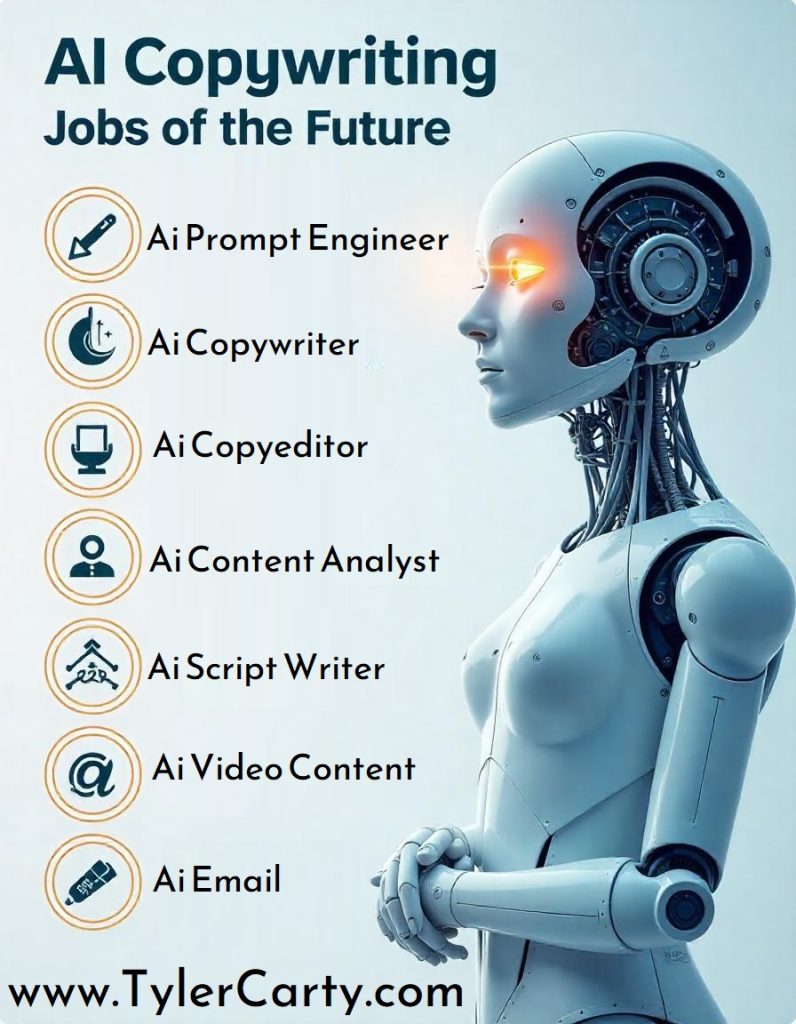
Top 20 AI Copywriting Jobs of the Future:
Let’s take a look at the hottest positions in the field, ranked from most in-demand to least. Remember, this list is dynamic and ever-changing, just like the AI landscape itself!
AI Prompt Engineer
Picture this: you’re the puppet master behind the AI curtain, crafting the perfect prompts that make AI dance to your tune. As an AI Prompt Engineer, you’re not just writing; you’re orchestrating a symphony of words that guide AI to produce exactly what you envision.
This role is perfect for the detail-oriented wordsmith with a knack for problem-solving. You’ll need to think like both a human and a machine, understanding the nuances of language that make AI tick. It’s like being a translator between the world of human creativity and artificial intelligence.
In the past, copywriters might have spent hours brainstorming ideas and crafting initial drafts. Now, as an AI Prompt Writing Engineer, you’ll be setting the stage for AI to generate multiple options in seconds. But here’s the kicker: your expertise in crafting the perfect prompt will be the difference between mediocre output and mind-blowing content.
The demand for this role is skyrocketing. Companies are realizing that the quality of AI-generated content is directly tied to the quality of the prompts. It’s like having a genie in a bottle – the wishes you get depend entirely on how you ask for them.
If you’ve got a background in creative writing or technical writing, you’re already halfway there. The key skills you’ll need to develop include a deep understanding of AI language models, an ability to think in structured, logical ways, and a flair for creative problem-solving.
So, if you’re the type who loves puzzles, enjoys finding the perfect word, and gets a thrill from seeing your ideas come to life in unexpected ways, AI Prompt Engineering might just be your dream job in the brave new world of AI copywriting.
AI-Human Collaboration Facilitator
Imagine being the bridge between human creativity and AI efficiency – that’s exactly what an AI-Human Collaboration Facilitator does. This role is perfect for those who thrive on teamwork and have a knack for bringing out the best in both people and technology.
As a Collaboration Facilitator, you’ll be orchestrating a beautiful dance between human intuition and AI capabilities. You’ll guide copywriting teams on how to leverage AI tools effectively, ensuring that the human touch isn’t lost in the process. It’s like being a conductor, harmonizing the strengths of both worlds to create a masterpiece.
In the past, copywriting was often a solitary endeavor or involved brainstorming sessions with other writers. Now, you’ll be facilitating sessions where humans and AI work side by side. You might start a project by having AI generate initial ideas, then work with human copywriters to refine and elevate these concepts, bringing in that crucial emotional intelligence that AI still lacks.
The demand for this role is booming as companies realize that the magic happens when AI and humans work together seamlessly. It’s not about replacing humans, but about creating a synergy that produces results neither could achieve alone.
If you have a background in project management or team leadership in the copywriting world, you’re well-positioned for this role. The key skills you’ll need to develop include a deep understanding of AI copywriting tools, excellent communication abilities, and the capacity to see the big picture while managing details.
This job is ideal for those who love bringing people together, are excited by new technologies, and have a passion for pushing the boundaries of what’s possible in copywriting. If you’re the type who gets a thrill from seeing diverse elements come together to create something amazing, this could be your calling in the AI copywriting landscape.
AI Copywriting Trainer
Step into the shoes of an AI Copywriting Trainer, and you’ll find yourself at the forefront of shaping the future of AI in our industry. This role is tailor-made for those who have a deep understanding of copywriting principles and a passion for teaching – even when your student is an artificial intelligence.
As an AI Copywriting Trainer, you’ll be responsible for ‘educating’ AI systems on the finer points of copywriting. Think of it as being a professor at the most cutting-edge university imaginable, where your pupils are algorithms eager to learn the art and science of persuasive writing.
In the past, senior copywriters might have mentored junior staff, passing on their knowledge through feedback and guidance. Now, you’ll be doing something similar, but with AI as your protégé. You’ll be feeding AI systems with high-quality examples of copywriting, helping to fine-tune their understanding of tone, style, and effective persuasion techniques.
The demand for this role is growing rapidly as companies invest in developing AI systems that can produce increasingly sophisticated copy. Your expertise will be crucial in ensuring that these AI tools don’t just churn out generic content, but truly understand the nuances that make copy compelling and effective.
If you have years of experience in copywriting and have always enjoyed the mentoring aspect of your role, this could be the perfect transition for you. The key skills you’ll need to develop include a deep understanding of machine learning processes, data analysis, and the ability to break down complex copywriting concepts into teachable components.
This job is perfect for those who love to dive deep into the ‘why’ behind effective copy, enjoy problem-solving, and get satisfaction from seeing continuous improvement. If you’re excited by the idea of shaping the future of AI copywriting and leaving your mark on the industry for years to come, this role could be your calling in the AI copywriting revolution.
AI Integration Specialist
Picture yourself as the architect of a seamless fusion between traditional copywriting practices and cutting-edge AI technology. That’s the exciting world of an AI Integration Specialist in the copywriting industry. This role is perfect for those who have a foot in both camps – a solid foundation in copywriting and a keen interest in technological advancements.
As an AI Integration Specialist, you’ll be the go-to expert for organizations looking to incorporate AI into their copywriting processes. You’ll assess current workflows, identify areas where AI can add value, and design strategies to implement these tools effectively. It’s like being a matchmaker, finding the perfect balance between human creativity and AI efficiency.
In the past, implementing new tools in copywriting might have meant introducing a new content management system or collaboration platform. Now, you’re bringing in sophisticated AI systems that can generate content, analyze performance, and even predict trends. Your role is to ensure this integration is smooth, beneficial, and aligned with the organization’s goals and brand voice.
The demand for this role is skyrocketing as more companies recognize the potential of AI in copywriting but lack the expertise to implement it effectively. You’ll be the bridge between the tech world and the creative realm, translating complex AI capabilities into practical applications for copywriting teams.
If you have a background in copywriting and have always been the ‘tech-savvy’ one in your team, this could be your moment to shine. The key skills you’ll need to develop include a deep understanding of various AI copywriting tools, project management abilities, and excellent communication skills to explain complex concepts to diverse audiences.
This job is ideal for those who love solving puzzles, enjoy being at the forefront of innovation, and have a talent for seeing the big picture while managing the details. If you’re excited by the idea of shaping how organizations approach copywriting in the AI age, this role could be your perfect niche in the evolving landscape of AI copywriting.
AI-Driven Content Creator
Welcome to the future of content creation! As an AI-Driven Content Creator, you’re not just a copywriter – you’re a maestro orchestrating a symphony of words with AI as your instrument. This role is perfect for those who love to push the boundaries of creativity and aren’t afraid to embrace new technologies.
In this position, you’ll be leveraging AI tools to supercharge your content creation process. But don’t worry, you’re not being replaced by AI – you’re becoming a super-powered version of yourself. Think of it as having a tireless assistant who can generate ideas, draft content, and even optimize for SEO at lightning speed, all under your expert guidance.
In the past, content creation often involved hours of research, brainstorming, and writing multiple drafts. Now, you’ll be able to generate a wealth of content ideas and rough drafts in minutes, allowing you to focus your energy on refining, personalizing, and adding that crucial human touch that turns good content into great content.
The demand for AI-Driven Content Creators is exploding as companies realize the potential for producing high-quality, targeted content at scale. Your role will be crucial in ensuring that this AI-assisted copywriting maintains brand voice, resonates with the target audience, and achieves marketing objectives.
If you’re a copywriter who’s always been curious about technology and loves to experiment with new tools, this role could be your perfect next step. The key skills you’ll need to develop include proficiency with various AI writing tools, a strong understanding of content strategy, and the ability to edit and refine AI-generated content effectively.
This job is ideal for those who thrive on variety, enjoy a fast-paced environment, and get excited about the possibilities of combining human creativity with AI efficiency. If you’re ready to ride the wave of the future and become a content creation powerhouse, the role of AI-Driven Content Creator could be your ticket to an exciting and rewarding career in the new era of copywriting.
AI Copywriting Strategy Analyst
Step into the shoes of an AI Copywriting Strategy Analyst, and you’ll find yourself at the intersection of data science and creative writing. This role is perfect for the analytical minds who also have a flair for compelling copy – a true blend of art and science.
As an AI Copywriting Strategy Analyst, you’ll be the mastermind behind data-driven copywriting strategies. Your job is to analyze the performance of AI-generated content, identify trends, and use these insights to refine and optimize future copywriting efforts. It’s like being a detective, but instead of solving crimes, you’re cracking the code of what makes copy truly effective in the AI age.
In the past, copywriters might have relied on A/B testing and gut instinct to refine their approach. Now, you’ll have access to vast amounts of data on how audiences interact with AI-generated content. Your role is to make sense of this data deluge and translate it into actionable strategies for both human copywriters and AI systems.
The demand for this role is growing rapidly as companies realize the power of combining AI-generated content with data-driven insights. Your expertise will be crucial in ensuring that AI copywriting efforts are not just productive, but truly effective in achieving marketing goals.
If you have a background in copywriting and have always been fascinated by the metrics behind successful campaigns, this could be your dream job. The key skills you’ll need to develop include data analysis, proficiency with AI tools, and the ability to translate complex data insights into clear, actionable copywriting strategies.
This job is perfect for those who love solving puzzles, enjoy diving deep into analytics, and get a thrill from seeing how small tweaks can lead to big improvements in performance. If you’re excited by the idea of being the strategic brain behind AI-powered copywriting campaigns, this role could be your calling in the evolving landscape of AI copywriting.
AI Content Refinement Specialist
Imagine being the final touch artist in the world of AI-generated content – that’s exactly what an AI Content Refinement Specialist does. This role is perfect for those who have an eye for detail, a passion for polishing copy to perfection, and the ability to infuse AI-generated content with that crucial human touch.
As an AI Content Refinement Specialist, you’ll be the bridge between raw AI output and finely crafted copy that resonates with human readers. Your job is to take the content generated by AI tools and elevate it, ensuring it aligns perfectly with brand guidelines, captures the right tone, and connects emotionally with the target audience. It’s like being a sculptor, taking the rough marble of AI-generated text and chiseling it into a masterpiece.
In the past, copywriters might have spent hours crafting and refining their own work. Now, you’ll be starting with a base of AI-generated content, allowing you to focus your energy on the higher-level aspects of copywriting – the nuances, the emotional hooks, the perfect turns of phrase that really make copy sing.
The demand for this role is surging as companies realize that while AI can generate content quickly, it often needs a human touch to truly excel. Your expertise will be crucial in ensuring that AI-generated copy doesn’t just pass muster, but truly shines and achieves its marketing objectives.
If you have a background in editing or have always been the go-to person for polishing others’ work, this could be your perfect niche. The key skills you’ll need to develop include a deep understanding of brand voice and tone, the ability to quickly identify and correct weaknesses in copy, and a knack for adding those human elements that AI still struggles with – humor, empathy, and cultural nuance.
This job is ideal for those who love the craft of writing, enjoy the challenge of working with diverse content types, and get satisfaction from turning good copy into great copy. If you’re excited by the idea of being the final guardian of quality in the AI copywriting process, the role of AI Content Refinement Specialist could be your calling in this new era of content creation.
AI Copywriting Data Analyst
Step into the world of AI Copywriting Data Analyst, where numbers tell stories and data drives creativity. This role is perfect for those who love diving into analytics but also have a deep appreciation for the art of copywriting. It’s where left-brain analysis meets right-brain creativity in a fascinating dance.
As an AI Copywriting Data Analyst, you’ll be the decoder of digital whispers, interpreting vast amounts of data to uncover insights that shape copywriting strategies. Your job is to analyze how audiences interact with AI-generated content, identify patterns in successful copy, and use these findings to continually refine and improve the AI copywriting process. It’s like being a modern-day oracle, but instead of reading tea leaves, you’re reading data points to predict what will resonate with audiences.
In the past, copywriters might have relied on focus groups or surveys to gauge audience response. Now, you’ll have access to real-time data on how every word, phrase, and call-to-action performs across various platforms and audiences. Your role is to make sense of this wealth of information and translate it into actionable insights for both AI systems and human copywriters.
The demand for this role is exploding as companies realize the power of data-driven copywriting. Your expertise will be crucial in ensuring that AI copywriting efforts are not just creative, but also highly targeted and effective based on concrete data.
If you have a background in data analysis and have always been fascinated by the psychology behind effective copy, this could be your dream job. The key skills you’ll need to develop include proficiency with data analysis tools, a deep understanding of copywriting principles, and the ability to communicate complex data insights in a way that non-technical team members can understand and act upon.
This job is perfect for those who love solving puzzles, enjoy finding patterns in large datasets, and get excited about using data to drive creative decisions. If you’re thrilled by the idea of being the numbers guru behind AI-powered copywriting strategies, this role could be your niche in the evolving landscape of AI copywriting.
AI-Generated Work Auditor
Welcome to the world of the AI-Generated Work Auditor, where you’ll be the guardian of quality in the AI copywriting revolution. This role is perfect for those with a keen eye for detail, a deep understanding of copywriting principles, and a commitment to maintaining high standards in the age of AI-generated content.
As an AI-Generated Work Auditor, you’ll be the final checkpoint before AI-created copy goes live. Your job is to review and verify AI-generated content for quality, accuracy, brand alignment, and potential biases. It’s like being a combination of editor, fact-checker, and brand guardian, all rolled into one crucial role.
In the past, senior copywriters or editors might have been responsible for reviewing and approving copy before publication. Now, you’ll be applying that same critical eye to content produced by AI systems, ensuring that it meets the same high standards as human-generated copy. Your role is to catch any errors, inconsistencies, or off-brand messaging that might slip through the AI’s algorithms.
The demand for this role is growing as companies increasingly rely on AI for content creation but recognize the need for human oversight. Your expertise will be crucial in maintaining trust in AI-generated content and ensuring that it aligns with brand values and messaging.
If you have a background in editing, quality assurance, or have always been the detail-oriented member of your copywriting team, this could be your perfect niche. The key skills you’ll need to develop include a deep understanding of AI copywriting capabilities and limitations, strong analytical skills, and the ability to quickly identify and correct issues in diverse types of content.
This job is ideal for those who enjoy the challenge of maintaining high standards, have a passion for accuracy and consistency, and get satisfaction from improving and perfecting content. If you’re excited by the idea of being the last line of defense in ensuring the quality of AI-generated copy, the role of AI-Generated Work Auditor could be your calling in the new era of copywriting.
AI Copywriting Ethicist
Step into the shoes of an AI Copywriting Ethicist, and you’ll find yourself at the forefront of one of the most important aspects of the AI revolution in copywriting. This role is perfect for those who have a strong moral compass, a deep understanding of the societal impacts of marketing, and a passion for ensuring that technology is used responsibly.
As an AI Copywriting Ethicist, you’ll be the conscience of the AI copywriting world. Your job is to ensure that AI-generated content adheres to ethical standards, avoids harmful biases, and promotes responsible marketing practices. It’s like being a combination of philosopher, policy maker, and watchdog for the AI copywriting industry.
In the past, copywriters might have relied on industry standards and personal ethics to guide their work. Now, you’ll be developing new ethical frameworks specifically for AI-generated content, addressing unique challenges such as transparency, data privacy, and the potential for AI to inadvertently produce misleading or manipulative content.
The demand for this role is growing as companies and consumers alike become more aware of the ethical implications of AI in marketing. Your expertise will be crucial in building trust in AI-generated content and ensuring that the power of AI is used to create positive, truthful, and socially responsible marketing messages.
If you have a background in ethics, policy, or have always been passionate about the social responsibility of marketing, this could be your dream job. The key skills you’ll need to develop include a deep understanding of AI technologies, knowledge of marketing regulations and best practices, and the ability to navigate complex ethical dilemmas.
This job is perfect for those who are passionate about doing the right thing, enjoy grappling with complex moral questions, and want to make a positive impact on the future of marketing. If you’re excited by the idea of shaping the ethical landscape of AI copywriting, this role could be your calling in the evolving world of AI-driven content creation.
Legal AI Prompt Specialist
Welcome to the intriguing world of the Legal AI Prompt Specialist, where the precision of legal language meets the innovation of AI technology. This role is tailor-made for those who have a background in legal writing or paralegal work and are excited about the possibilities of AI in the legal field.
As a Legal AI Prompt Specialist, you’ll be the bridge between the complex world of legal jargon and the capabilities of AI language models. Your job is to craft precise, legally sound prompts that guide AI systems in generating accurate legal content, from contract clauses to legal summaries. It’s like being a legal translator, but instead of translating between human languages, you’re translating legal concepts into a language that AI can understand and work with effectively.
In the past, legal copywriting was a time-consuming process that required extensive human expertise. Now, you’ll be leveraging AI to speed up this process while ensuring that the output maintains the necessary legal accuracy and nuance. Your role is crucial in making sure that AI-generated legal content is not just fast, but also reliable and compliant with legal standards.
The demand for this role is growing as law firms and legal departments recognize the potential of AI to streamline their documentation processes. Your expertise will be vital in ensuring that AI tools can be trusted to handle sensitive legal information and produce content that stands up to legal scrutiny.
If you have a background in legal writing and have always been interested in technology, this could be your perfect niche. The key skills you’ll need to develop include a deep understanding of legal terminology and concepts, familiarity with AI language models, and the ability to craft clear, unambiguous prompts that produce the desired legal content.
This job is ideal for those who enjoy the precision of legal language, are excited by the challenge of working with cutting-edge technology, and want to be at the forefront of innovation in the legal field. If you’re thrilled by the idea of making legal processes more efficient through AI while maintaining the highest standards of accuracy, the role of Legal AI Prompt Specialist could be your calling in the evolving landscape of AI-assisted legal writing.
AI Chatbot Conversation Designer
Step into the exciting world of AI Chatbot Conversation Designer, where you’ll be crafting the personality and dialogue of the digital assistants that are becoming increasingly prevalent in our online interactions. This role is perfect for those who have a flair for dialogue writing, a deep understanding of brand voice, and a passion for creating engaging user experiences.
As an AI Chatbot Conversation Designer, you’ll be the puppeteer behind the curtain, scripting the responses and guiding the conversational flow of AI chatbots. Your job is to ensure that these digital interactions are not just functional, but also engaging, on-brand, and as human-like as possible. It’s like being a screenwriter, but instead of writing for actors, you’re writing for AI that will interact with thousands or even millions of users.
In the past, customer service scripts or FAQ pages might have been the extent of pre-planned customer interactions. Now, you’ll be creating dynamic conversation trees that can handle a wide range of queries and situations, all while maintaining a consistent and appropriate tone. Your role is to anticipate user needs, craft witty responses, and ensure that the chatbot can handle even the most unexpected turns in conversation.
The demand for this role is skyrocketing as more companies implement chatbots as part of their customer service and marketing strategies. Your expertise will be crucial in ensuring that these AI interactions enhance rather than frustrate the user experience, building positive brand associations through every interaction.
If you have a background in copywriting, particularly in areas like social media or customer service, and have always been fascinated by the way people communicate, this could be your dream job. The key skills you’ll need to develop include a deep understanding of conversational UI/UX, knowledge of AI chatbot capabilities and limitations, and the ability to write in a variety of voices and styles to suit different brands and situations.
This job is perfect for those who love crafting dialogue, enjoy the challenge of problem-solving through conversation, and get excited about the possibilities of human-AI interaction. If you’re thrilled by the idea of shaping the way brands communicate with their customers in the digital age, the role of AI Chatbot Conversation Designer could be your calling in the new frontier of AI-assisted communication.
AI Social Media Content Optimizer
Welcome to the dynamic world of the AI Social Media Content Optimizer, where the fast-paced nature of social media meets the power of AI-driven content creation. This role is perfect for those who have a finger on the pulse of social media trends and a knack for creating content that captures attention in crowded feeds.
As an AI Social Media Content Optimizer, you’ll be the mastermind behind social media strategies that leverage AI to create, test, and optimize content across various platforms. Your job is to work with AI tools to generate a wide range of social media posts, then analyze performance data to continually refine and improve your approach. It’s like being a social media manager with superpowers, able to create and test content at a scale that was previously impossible.
In the past, social media managers might have spent hours brainstorming post ideas and manually scheduling content. Now, you’ll be using AI to generate multiple options for each post, predict the best times to share, and even tailor content for different audience segments. Your role is to guide this AI-driven process, ensuring that the content remains authentic to the brand voice and resonates with the target audience.
The demand for this role is exploding as companies realize the potential of AI to enhance their social media presence. Your expertise will be crucial in navigating the ever-changing landscape of social media algorithms and user preferences, using AI as a tool to stay ahead of the curve.
If you have a background in social media marketing and have always been excited about new technologies, this could be your perfect niche. The key skills you’ll need to develop include proficiency with AI-powered social media tools, a deep understanding of social media analytics, and the ability to translate data insights into creative content strategies.
This job is ideal for those who thrive in fast-paced environments, enjoy the challenge of staying current with social media trends, and get excited about using data to drive creative decisions. If you’re thrilled by the idea of harnessing AI to create social media content that truly connects with audiences, the role of AI Social Media Content Optimizer could be your calling in the evolving world of digital marketing.
AI Email Marketing Specialist
Step into the world of the AI Email Marketing Specialist, where the art of crafting compelling emails meets the science of AI-driven personalization and optimization. This role is perfect for those who have a knack for email marketing and are excited about leveraging AI to take their campaigns to the next level.
As an AI Email Marketing Specialist, you’ll be the architect of highly targeted, personalized email campaigns that use AI to maximize engagement and conversions. Your job is to work with AI tools to generate email content, segment audiences, predict the best send times, and continuously optimize based on performance data. It’s like being a traditional email marketer, but with the ability to create and test hundreds of variations in the time it used to take to craft a single campaign.
In the past, email marketers might have relied on basic segmentation and A/B testing to improve their campaigns. Now, you’ll be using AI to create dynamic content that changes based on individual user behavior, predicts which subject lines will perform best for different segments, and even generates personalized product recommendations. Your role is to guide this AI-driven process, ensuring that the emails remain on-brand and genuinely helpful to recipients.
The demand for this role is growing rapidly as companies recognize the potential of AI to revolutionize email marketing. Your expertise will be crucial in navigating the complex world of email deliverability, engagement metrics, and privacy regulations, all while leveraging AI to create more effective campaigns.
If you have a background in email marketing and have always been fascinated by data-driven optimization, this could be your dream job. The key skills you’ll need to develop include proficiency with AI-powered email marketing tools, a deep understanding of email metrics and analytics, and the ability to craft compelling email copy that works in tandem with AI-generated elements.
This job is perfect for those who enjoy the challenge of creating content that drives action, are excited by the possibilities of hyper-personalization, and get a thrill from seeing their campaigns achieve impressive results. If you’re excited by the idea of using AI to create email marketing campaigns that truly resonate with each individual recipient, the role of AI Email Marketing Specialist could be your calling in the evolving landscape of digital marketing.
AI SEO Copywriter
Welcome to the fascinating world of the AI SEO Copywriter, where the art of persuasive writing meets the science of search engine optimization, all powered by cutting-edge AI technology. This role is perfect for those who have a way with words and a passion for cracking the code of search engine algorithms.
As an AI SEO Copywriter, you’ll be the architect of content that not only engages human readers but also ranks highly in search engine results. Your job is to work with AI tools to generate SEO-optimized content, analyze keyword opportunities, and continuously refine your approach based on search trends and algorithm updates. It’s like being a traditional SEO copywriter, but with AI as your research assistant, data analyst, and co-writer all rolled into one.
In the past, SEO copywriters might have spent hours researching keywords, analyzing competitor content, and manually optimizing their writing. Now, you’ll be using AI to generate keyword-rich content drafts, predict search trends, and even analyze the semantic relevance of your content to search queries. Your role is to guide this AI-driven process, ensuring that the content remains engaging and valuable to human readers while also ticking all the boxes for search engine algorithms.
The demand for this role is skyrocketing as companies realize the potential of AI to enhance their SEO efforts. Your expertise will be crucial in navigating the ever-changing landscape of search engine algorithms, using AI as a tool to stay ahead of the curve and consistently produce content that ranks well.
If you have a background in SEO copywriting and have always been excited about new technologies, this could be your perfect niche. The key skills you’ll need to develop include proficiency with AI-powered SEO tools, a deep understanding of search engine algorithms and ranking factors, and the ability to craft compelling copy that seamlessly incorporates SEO elements.
This job is ideal for those who enjoy the challenge of writing for both humans and algorithms, are excited by the possibilities of data-driven content creation, and get a thrill from seeing their content climb the search rankings. If you’re thrilled by the idea of using AI to create content that not only reads well but also performs exceptionally in search results, the role of AI SEO Copywriter could be your calling in the evolving world of digital marketing.
AI Voice and Tone Specialist
Step into the shoes of an AI Voice and Tone Specialist, where you’ll be the guardian of brand personality in the age of AI-generated content. This role is perfect for those who have a keen ear for language nuances and a talent for capturing the essence of a brand in words.
As an AI Voice and Tone Specialist, you’ll be the maestro ensuring that AI-generated content consistently hits the right notes when it comes to brand voice. Your job is to train AI systems to understand and replicate the unique voice and tone of different brands across various types of content. It’s like being a brand’s vocal coach, but instead of working with human speakers, you’re fine-tuning AI to sing in perfect harmony with the brand’s personality.
In the past, maintaining consistent brand voice across content was a challenge even with human writers. Now, you’ll be leveraging AI to generate content at scale while ensuring it always sounds authentically on-brand. Your role is to develop detailed voice and tone guidelines that can be translated into parameters for AI systems, and to continually refine these based on output and brand evolution.
The demand for this role is growing as companies realize the importance of maintaining a consistent brand voice across the increasing volume of AI-generated content. Your expertise will be crucial in ensuring that AI doesn’t just produce generic content, but truly captures the unique personality of each brand it writes for.
If you have a background in branding, copywriting, or linguistics, and have always been fascinated by the way brands express themselves through language, this could be your dream job. The key skills you’ll need to develop include a deep understanding of linguistic style markers, proficiency in training AI language models, and the ability to articulate subtle language nuances in a way that can be understood and implemented by AI systems.
This job is perfect for those who have a passion for language, enjoy the challenge of defining and maintaining brand identities, and are excited about the intersection of creativity and technology. If you’re thrilled by the idea of ensuring that AI can speak fluently in any brand’s voice, the role of AI Voice and Tone Specialist could be your calling in the new frontier of AI-assisted branding and communication.
AI Multilingual Content Adaptor
Welcome to the global stage of AI Multilingual Content Adaptor, where the power of AI meets the nuances of cross-cultural communication. This role is perfect for those who have a passion for languages, a deep understanding of cultural differences, and a knack for ensuring messages resonate across diverse audiences.
As an AI Multilingual Content Adaptor, you’ll be the bridge between AI-generated content and multilingual, multicultural audiences. Your job is to work with AI translation tools to not just translate content, but to adapt it culturally, ensuring that the message maintains its impact and appropriateness across different languages and cultures. It’s like being a cultural diplomat, but with AI as your linguistic co-pilot.
In the past, adapting content for different markets often involved working with teams of translators and local market experts. Now, you’ll be leveraging AI to generate initial translations and cultural adaptations at scale. Your role is to fine-tune these AI outputs, ensuring that idioms, cultural references, and tone are appropriate for each target market.
The demand for this role is exploding as companies expand their global reach and realize the potential of AI in breaking down language barriers. Your expertise will be crucial in ensuring that AI-generated multilingual content is not just linguistically accurate, but culturally resonant and sensitive.
If you have a background in translation, localization, or international marketing, and have always been excited about the potential of technology to connect global audiences, this could be your perfect niche. The key skills you’ll need to develop include proficiency with AI translation and cultural adaptation tools, a deep understanding of cross-cultural communication principles, and the ability to spot and correct cultural missteps in AI-generated content.
This job is ideal for those who love exploring different cultures, enjoy the challenge of making messages work across diverse contexts, and are excited about the possibilities of AI in global communication. If you’re thrilled by the idea of using AI to create content that truly speaks to audiences around the world, the role of AI Multilingual Content Adaptor could be your calling in the evolving landscape of global marketing and communication.
AI Content Performance Analyst
Step into the world of the AI Content Performance Analyst, where data meets creativity in a fascinating dance of numbers and words. This role is perfect for those who love diving deep into analytics but also have a keen appreciation for the art of content creation.
As an AI Content Performance Analyst, you’ll be the decoder of digital success, interpreting vast amounts of data to uncover insights that shape content strategies. Your job is to analyze how audiences interact with AI-generated content across various platforms, identify patterns in high-performing pieces, and use these findings to continually refine and improve the AI content creation process. It’s like being a modern-day fortune teller, but instead of reading tea leaves, you’re reading data points to predict what content will resonate with audiences.
In the past, content analysts might have relied on basic metrics like page views or time on page. Now, you’ll have access to sophisticated AI tools that can analyze sentiment, predict engagement, and even correlate content performance with business outcomes. Your role is to make sense of this wealth of information and translate it into actionable insights for both AI systems and human content creators.
The demand for this role is growing rapidly as companies realize the power of data-driven content creation. Your expertise will be crucial in ensuring that AI-generated content isn’t just produced efficiently, but also performs exceptionally well in achieving marketing and business objectives.
If you have a background in data analysis and have always been fascinated by what makes content go viral or convert, this could be your dream job. The key skills you’ll need to develop include proficiency with AI-powered analytics tools, a deep understanding of content marketing principles, and the ability to communicate complex data insights in a way that content creators and marketers can understand and act upon.
This job is perfect for those who love solving puzzles, enjoy finding patterns in large datasets, and get excited about using data to drive creative decisions. If you’re thrilled by the idea of being the numbers guru behind high-performing AI-generated content, this role could be your niche in the evolving landscape of digital marketing.
AI Creative Writing Coach
Welcome to the inspiring world of the AI Creative Writing Coach, where the boundless creativity of human imagination meets the analytical power of artificial intelligence. This role is perfect for those who have a passion for creative writing and a talent for nurturing the creative spark in others.
As an AI Creative Writing Coach, you’ll be the guide and mentor for both aspiring and established writers, leveraging AI tools to enhance their creative process. Your job is to use AI-powered writing assistants to help writers overcome blocks, generate ideas, and refine their craft. It’s like being a traditional writing coach, but with an AI co-pilot that can provide instant feedback, suggest plot twists, or even generate character backstories.
In the past, writing coaches relied solely on their own experience and intuition to guide writers. Now, you’ll be able to draw on the collective knowledge of millions of books and writing styles, all processed and analyzed by AI. Your role is to bridge the gap between this vast AI knowledge and the unique voice and vision of each individual writer you coach.
The demand for this role is growing as writers of all levels recognize the potential of AI to enhance their creative process. Your expertise will be crucial in helping writers navigate the world of AI writing tools, ensuring they use these technologies to amplify their creativity rather than stifle it.
If you have a background in creative writing or teaching and have always been excited about new technologies, this could be your perfect niche. The key skills you’ll need to develop include a deep understanding of storytelling principles, proficiency with AI writing tools, and the ability to provide constructive feedback that balances AI-generated suggestions with human creativity.
This job is ideal for those who love nurturing talent, enjoy the process of creative problem-solving, and are excited about the possibilities of AI in the world of literature. If you’re thrilled by the idea of using AI to help writers unlock their full potential and create compelling stories, the role of AI Creative Writing Coach could be your calling in the evolving landscape of creative writing.
AI Copywriting Compliance Specialist
Step into the crucial role of AI Copywriting Compliance Specialist, where the innovation of AI meets the stringent requirements of regulatory compliance. This position is ideal for those who have a meticulous eye for detail, a strong understanding of marketing regulations, and a passion for ensuring ethical standards in AI-generated content.
As an AI Copywriting Compliance Specialist, you’ll be the guardian of legal and ethical standards in the world of AI-generated marketing content. Your job is to ensure that all AI-produced copy adheres to industry regulations, platform-specific rules, and ethical marketing practices. It’s like being a combination of legal advisor and ethical compass for AI copywriting systems.
In the past, compliance checks were often done manually, with human reviewers poring over content. Now, you’ll be working with AI tools to automate much of this process, but your expertise will be crucial in setting up these systems, interpreting complex regulations, and making judgment calls on grey areas that AI might struggle with.
The demand for this role is skyrocketing as companies increasingly rely on AI for content creation while facing growing scrutiny over marketing practices. Your expertise will be vital in maintaining trust with consumers, avoiding costly legal issues, and ensuring that AI-generated content meets the highest standards of compliance and ethics.
If you have a background in marketing law, compliance, or have always been the go-to person for ensuring content meets guidelines, this could be your perfect niche. The key skills you’ll need to develop include a deep understanding of marketing regulations across various industries and platforms, familiarity with AI copywriting systems, and the ability to translate complex legal requirements into parameters that can guide AI content generation.
This job is perfect for those who enjoy the challenge of navigating complex regulatory landscapes, have a strong ethical compass, and are excited about shaping the future of responsible AI use in marketing. If you’re thrilled by the idea of ensuring that AI-generated copy not only persuades but also protects both the brand and the consumer, the role of AI Copywriting Compliance Specialist could be your calling in the evolving world of AI-driven marketing.
AI working together with Humans
As we wrap up our exploration of these exciting new roles in AI copywriting, it’s clear that the future of our industry is not just about AI replacing human creativity, but about humans and AI working together to achieve new heights of marketing excellence. Each of these roles represents a unique opportunity to shape the future of copywriting, leveraging the power of AI while maintaining the human touch that makes great copy truly resonate.
The transition to AI copywriting is not about losing jobs, but about evolving our skills and finding new ways to add value. It’s about embracing the tools that can free us from mundane tasks and allow us to focus on higher-level strategy, creativity, and human insight. The copywriters who thrive in this new landscape will be those who see AI not as a threat, but as a powerful ally in their creative journey.
So, what would the forefathers of modern copywriting say about this AI revolution? I believe they would be thrilled. Pioneers like David Ogilvy and Leo Burnett were always at the forefront of leveraging new technologies and insights to create more effective advertising. They understood that at its core, great copywriting is about understanding human psychology and crafting messages that resonate. AI is simply a new tool in our arsenal to do this more effectively and at scale.
The benefits of transitioning into an AI copywriting job are numerous. You’ll be at the cutting edge of marketing technology, able to create and test ideas at a scale previously unimaginable. You’ll have the opportunity to shape the future of an entire industry. And perhaps most excitingly, you’ll be able to focus more on the aspects of copywriting that require human creativity, empathy, and strategic thinking – the parts that many of us love most about this profession.
In conclusion, the AI copywriting revolution is not something to fear, but something to embrace with open arms. It’s an opportunity to grow, to learn, and to push the boundaries of what’s possible in marketing and communication. The future of copywriting is bright, and it’s waiting for bold, innovative professionals like you to shape it.
So, what are you waiting for? The world of AI copywriting is calling, and it’s time to answer. Start exploring these new roles, begin learning about AI technologies, and position yourself at the forefront of this exciting revolution. Your future in AI copywriting starts now – are you ready to write it?
Does Google Penalize AI Assisted Copywriting? Watch Video:
Ready to dive into the world of AI copywriting? Here’s what you can do right now:
Start learning about AI technologies in marketing. There are numerous online courses and resources available.
Experiment with AI writing tools to get a feel for their capabilities and limitations.
Join online communities and forums focused on AI in marketing to stay up-to-date with the latest developments.
Consider how your current skills might translate into one of the AI copywriting roles we’ve discussed.
Reach out to companies at the forefront of AI marketing to explore internship or entry-level opportunities.
Remember, the future of copywriting is being written right now. Make sure you’re part of the story!
About the Author:
Tyler Carty is a visionary in the world of AI-driven marketing and copywriting. With over a decade of experience in traditional copywriting and a passion for emerging technologies, Tyler has positioned himself at the forefront of the AI copywriting revolution. As a sought-after speaker, consultant, and thought leader, Tyler has helped numerous companies successfully integrate AI into their copywriting processes, achieving unprecedented results in engagement and conversion rates.
Tyler’s unique blend of creative writing skills and technical expertise makes him the perfect guide for copywriters looking to navigate the exciting new landscape of AI-assisted content creation. His blog, “The AI Copywriter’s Playbook,” has become a go-to resource for professionals seeking to stay ahead of the curve in this rapidly evolving field.
The Future of AI Copywriting. Watch Video Now!
Summary:
AI Prompt Engineer: Specialists who craft and optimize prompts for AI models to generate accurate and relevant content.
AI-Human Collaboration Facilitator: Professionals managing the synergy between AI tools and human copywriters.
AI Copywriting Trainer: Experts teaching AI systems to understand and process human language for copywriting.
AI Integration Specialist: Professionals helping organizations adopt AI technology for content creation.
AI-Driven Content Creator: Copywriters leveraging AI tools to develop targeted marketing strategies and content.
AI Copywriting Strategy Analyst: Experts analyzing AI-generated content and developing effective marketing strategies.
AI Content Refinement Specialist: Copywriters enhancing AI-generated content to align with brand guidelines.
AI Copywriting Data Analyst: Specialists interpreting data from AI tools to improve copywriting effectiveness.
AI-Generated Work Auditor: Individuals verifying AI-generated content for quality and accuracy.
AI Copywriting Ethicist: Specialists ensuring ethical development and use of AI in copywriting.
Legal AI Prompt Specialist: Experts managing AI prompts for legal content and applications.
AI Chatbot Conversation Designer: Professionals creating engaging chatbot dialogues using AI.
AI Social Media Content Optimizer: Specialists using AI to enhance social media marketing strategies.
AI Email Marketing Specialist: Experts leveraging AI for personalized and effective email campaigns.
AI SEO Copywriter: Professionals combining AI tools with SEO expertise for optimized content.
AI Voice and Tone Specialist: Experts fine-tuning AI-generated content to match specific brand voices.
AI Multilingual Content Adaptor: Specialists using AI for accurate and culturally appropriate translations.
AI Content Performance Analyst: Professionals analyzing and optimizing AI-generated content metrics.
AI Creative Writing Coach: Experts using AI to assist and improve creative writing processes.
AI Copywriting Compliance Specialist: Professionals ensuring AI-generated content adheres to industry regulations.