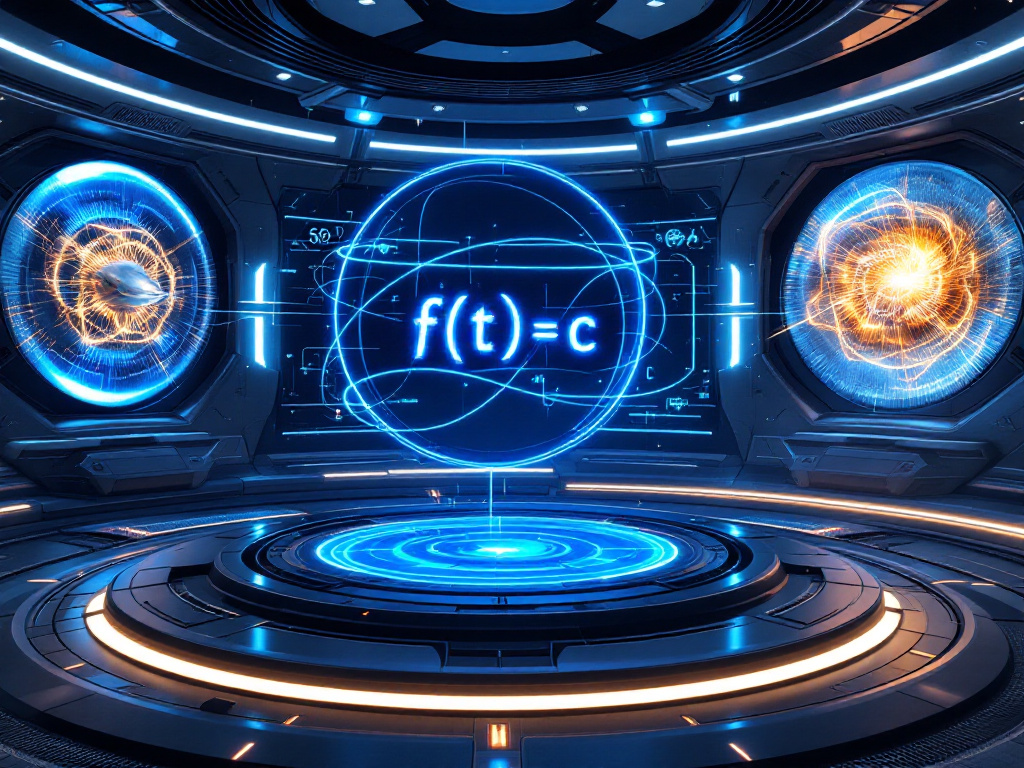

Then and there always is and always was before and after here and now.
If ( f(t) ) is constant, then for all values of ( t ) (representing any “then and there”), the function equals some fixed value, say ( c ). Mathematically:
f(t) = c, where ( c ) is a constant.
This means:
At t = 0 (“now”), f(0) = c.
Before now (t < 0), f(t) = c.
After now (t > 0), f(t) = c.
At any other time (“then”), f(t) = c.
The phrase “always is and always was” aligns with ( f(t) ) being ( c ) at all times, past and present, and its persistence “before and after” confirms this across the entire timeline.
Let’s test this against the statement:
“Then and there”: Any time ( t ), where f(t) = c.
“Always is and always was”: f(t) = c holds for all ( t ), including the past and present.
“Before and after here and now”: For t < 0 and t > 0 relative to t = 0, f(t) = c.
This interpretation fits: a constant function satisfies the idea that something remains true at all times, regardless of the reference point (“here and now”).
Could it be more complex, like a periodic function (repeating over time) or a condition involving specific times? The statement doesn’t suggest repetition or change, and “always” implies uninterrupted consistency, not cycles. A spatial component (f(x, t) = c) could be included, but the focus on “before and after” ties it more to time. The simplest, most direct interpretation is a time-invariant constant.
Final Equation
Thus, the statement describes a function that is constant for all time. The mathematical equation is:
f(t)=c